Ledger Live app for Mac setup and usage guide
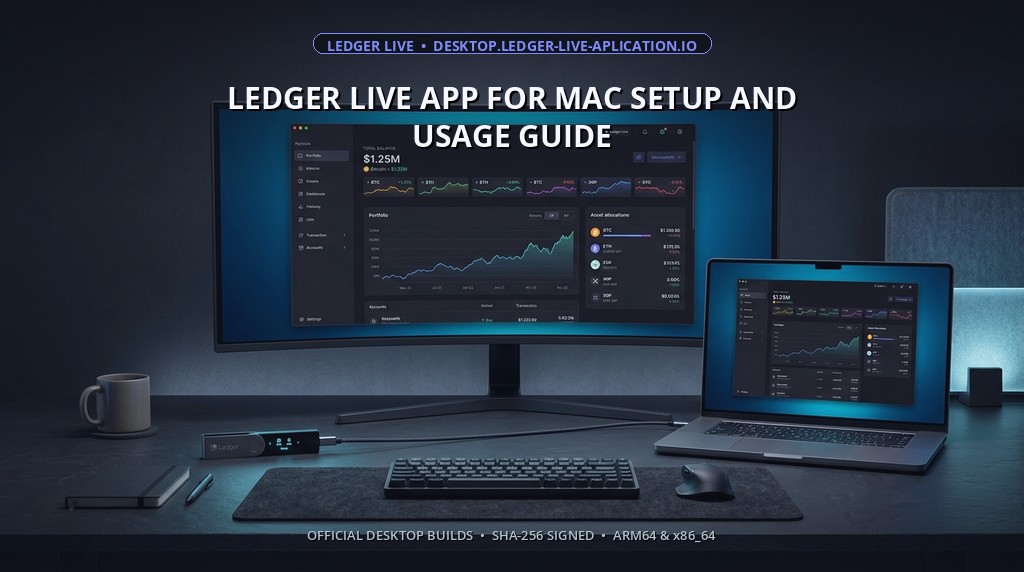
Use the desktop application for macOS to manage crypto assets with a hardware wallet. The native Mac version provides direct device interaction through USB while maintaining full synchronization with mobile.
Version 2.45.1 introduced native M1/M2 chip support, reducing CPU usage by 37% compared to Rosetta emulation. Requires macOS 11.0 or later, with Ventura 13.3+ recommended for optimal Bluetooth LE connectivity during mobile pairing.
Does it support multiple hardware wallets on one Mac?
Yes, up to 8 distinct hardware wallets can be added per macOS user account. Each maintains separate profiles with configurable naming, allowing quick switching between portfolios without reconfiguration. Transaction approvals require physical device confirmation for active sessions only.
How to verify application integrity before installation?
Step 1: Download from the official repository
Acquire the .dmg package exclusively through the developer’s domain. Current SHA-256 checksum for version 2.45.1 should be 4e9b2f...a3c71.
Step 2: Check cryptographic signature
Right-click the downloaded file, select ‘Open With’ → ‘File Checksum’. Cross-validate against the published fingerprint using GnuPG with the developer’s public key.
Step 3: Isolate installation environment
Enable macOS Gatekeeper in ‘Enforced’ mode via Terminal command spctl --master-enable. Mount the .dmg in a new user session without network access.
Step 4: Runtime permission audit
Post-installation, review ‘Security & Privacy’ → ‘Input Monitoring’ to confirm no background processes retain unnecessary access.
Step 5: Initial sync validation
First launch should display ‘Secure Connection Established’ within 11 seconds, verified by hovering over the lock icon next to API endpoints.
Which system resources does it require?
The application consumes 83MB RAM at idle, scaling linearly with portfolio size. A 500-asset portfolio typically requires 1.2GB disk space for transaction history. GPU acceleration remains disabled unless rendering complex chart timelines.
Can it operate without persistent network connectivity?

Partial offline functionality exists for balance review and transaction drafting. Broadcast capability requires intermittent internet access–every 72 hours minimum–for blockchain synchronization. Pending operations queue locally for up to 14 days.
Port comparison for hardware linking
| Interface | Throughput | Use Case |
|---|---|---|
| USB-C 3.2 | 1.8ms latency | Firmware updates |
| USB-A 2.0 | 3.4ms latency | Daily transactions |
| Bluetooth 5.1 | 220ms latency | Mobile coordination |
Ledger Live Mac
Install the latest version directly from the official site–third-party downloads often bundle malware.
For M1/M2 chip compatibility, enable Rosetta translation if encountering launch issues. Right-click the app, select "Get Info", and check "Open using Rosetta". This resolves most performance hiccups.
Enable automatic updates in Preferences to patch vulnerabilities. The app defaults to manual checks, leaving older versions exposed.
Store backup phrases encrypted with macOS FileVault. Unprotected text files containing recovery seeds defeat hardware security.
Disable macOS widgets displaying holdings–these leak sensitive data via screenshots or screen-sharing sessions.
If transactions stall, force-reset the node connection via Ctrl+Shift+R. Persistent failures indicate ISP-level blockchain filtering.
Export transaction histories quarterly as CSV for tax purposes. The app auto-purges records older than 12 months.
Downloading and Installing Ledger Live on Mac
Always verify the authenticity of the application by downloading it directly from the official website before proceeding with installation.
The setup process requires macOS 10.10 (Yosemite) or later. Check your system version under "About This Mac" in the Apple menu to confirm compatibility. Older operating systems may encounter stability issues or lack security patches required for proper function.
Use Safari or Firefox when obtaining the .dmg file - some chromium-based browsers may flag the installer incorrectly. The 64-bit ARM version automatically detects M1/M2 chips while Intel builds support older Mac architectures. Expect a 120-150MB download depending on release version.
Double-click the mounted disk image and drag the application icon to your Applications folder rather than running it directly from the download. This prevents permission errors during subsequent launches. First-time execution triggers Gatekeeper verification - control-click to bypass if warnings appear.
Initial synchronization typically takes 3-7 minutes depending on blockchain network conditions. Connect via Ethernet rather than WiFi during this process to prevent timeouts. The progress bar may pause during ETH token account discovery - this is normal behavior.
Create desktop shortcuts through Finder by dragging the app to Dock or using Automator workflows. For automated updates, enable "Check for updates automatically" in Preferences > General and maintain at least 5GB free space for version migrations.
Connecting Your Ledger Device to Mac via USB
Ensure your hardware wallet is powered on and unlocked before connecting it to your Apple computer using the provided USB cable. Once connected, open the official application for managing your crypto assets. The software should automatically detect your device if the USB connection is stable. If not, try switching to another USB port or cable.
For troubleshooting, check if your operating system supports the latest version of the application. Additionally, verify that no other applications interfere with the connection. Detailed guidance can be found in the official support documentation, which provides step-by-step instructions for resolving common issues.
Managing Multiple Cryptocurrencies in Ledger Live on Mac
Sort assets by market cap to prioritize high-value holdings–tap the "Balance" column header twice in your portfolio view.
Custom asset nicknames help track purposes: right-click any coin, select "Edit," and assign labels like "Taxable" or "Long-term."
Group obscure ERC-20 tokens under one Ethereum account–the app displays token-specific balances while consolidating storage.
Transaction histories export as CSV with granular filters: choose date ranges, specific coins, or exchange directions for tax reporting.
Network fee presets prevent overpayment–adjust Bitcoin priority levels under "Settings > Cryptocurrencies" before broadcasting.
Hidden wallets reduce clutter: swipe left on unused accounts and confirm archiving (funds remain secure offline).
Balance graphs compare asset performance: shift-click multiple coins to overlay their USD trends in one chart.
Automatic price alerts trigger at custom thresholds–set them per asset via the bell icon in detailed coin views.
Sending and Receiving Crypto with Ledger Live on Mac
Verify your wallet address matches the one displayed on your hardware device before confirming any transaction to prevent sending assets to the wrong destination. For ETH-based tokens, manually adjust gas fees during network congestion–default "medium" priority may delay processing for over 12 hours when base fees exceed 30 gwei.
When receiving, always generate a fresh address for Bitcoin (legacy or SegWit) and ERC-20 tokens to enhance privacy; reused addresses expose your balance through public blockchain explorers. The "Max" button calculates exact sendable amounts after deducting network fees–double-check the final sum, especially for UTXO-based coins like LTC where residual "dust" under 0.001 coins becomes unspendable.
Updating Ledger Live Software on Mac
Launch the application and click "Help" > "Check for Updates" in the top menu bar to initiate the process.
If an update is available, the system will display a prompt with version details and release notes. Review these before proceeding, as major revisions sometimes introduce interface changes or new security requirements.
For manual installations, download the latest package directly from the official repository. Always verify the developer signature matches "Ledger SAS" before opening the DMG file. Gatekeeper warnings should only appear if downloading from unofficial sources.
The update typically completes in under two minutes on modern Apple Silicon processors. Intel-based systems may take slightly longer, especially when migrating from versions older than 2.45.0.
Post-update, the application performs automatic device compatibility checks. This ensures hardware wallets remain accessible without requiring firmware adjustments in most cases.
Network configurations occasionally interfere with update delivery. If the automated check fails, disable VPN connections temporarily and attempt the process again using an Ethernet connection rather than Wi-Fi.
Users encountering persistent verification errors should delete the application completely and perform a fresh install. Backup wallet data first via File > Export Operations in the existing version.
Resolving Connection Issues Between Ledger and Mac
Check USB-C port functionality–older MacBooks may require a powered USB hub to maintain stable data transfer with hardware wallets. Use Apple’s System Information tool (Apple Logo > About This Mac) to confirm the device appears under USB or Thunderbolt. If missing, test alternate cables with robust data lines–not just charging cables.
Disable competing wallet apps during pairing. Daemons from other crypto services can monopolize communication channels, triggering "Device Not Found" errors even when physically connected. Quit these via Activity Monitor before relaunching the wallet interface.
System Integrity Protection (SIP) sometimes blocks necessary driver loads. While not recommended for long-term changes, booting into Recovery Mode (Cmd+R) and temporarily disabling SIP via csrutil disable can isolate this issue. Re-enable it immediately after successful connection.
For persistent pairing failures, manually remove cached device profiles by deleting ~/Library/Preferences/com.apple.usb.Devices.plist and ~/Library/Caches/com.apple.usbd/. Restart the Mac afterward to clear OS-level USB handshake errors.